Target audience: Technical founders, GTM engineers, data engineers
Core theme: Data sovereignty & composability
In 2026, the most sophisticated revenue teams aren’t just buying lists; they are engineering them. The era of renting your entire pipeline from closed-source, “black box” data monopolies (like Apollo or ZoomInfo) is fading. For the technical founder or GTM engineer, the priority has shifted to data sovereignty: owning the code, owning the database, and owning the API keys.
While the open-source CRM market has matured significantly, the enrichment layer—the engine that actually finds and verifies leads—has largely remained a proprietary secret. Until now.
Below is a comparison of the top open-source tools that form the modern, composable GTM stack, from the system of record to the engine of discovery.
The Landscape of Open Source GTM
To build a sovereign stack, you need three layers: Storage (CRM), Orchestration (Workflow), and Acquisition (Enrichment).
1. The System of Record: Twenty
- Best for: Developers who want a CRM that feels like a modern SaaS but runs on their own infrastructure.
- The tech: Built on TypeScript, React, and Nest.js, Twenty creates a seamless developer experience with a clean codebase and extensive GraphQL and REST APIs.
- The pros: Unlike legacy open-source CRMs (like SuiteCRM), Twenty offers a sleek, Notion-like UI and a visual workflow builder. It allows for “user impersonation” and extensive theming via styled components, making it highly customizable for internal teams.
- The gap: Twenty is a database for managing relationships, not finding them. It relies on external integrations to populate data. It doesn’t scrape; it stores.
2. The Internal Tooling Builder: NocoBase
- Best for: Teams building complex internal business systems that require embedded AI agents.
- The tech: A no-code/low-code platform designed for scalability, featuring a plugin-oriented architecture.
- The pros: NocoBase differentiates itself with “AI Employees”—intelligent agents embedded directly into the workflow. These agents can understand page-level data context, perform data cleaning, and structure unstructured text (like emails) into customer attributes.
- The gap: While powerful for processing data you already have, NocoBase is not an outbound prospecting engine. It excels at operations, not extraction.
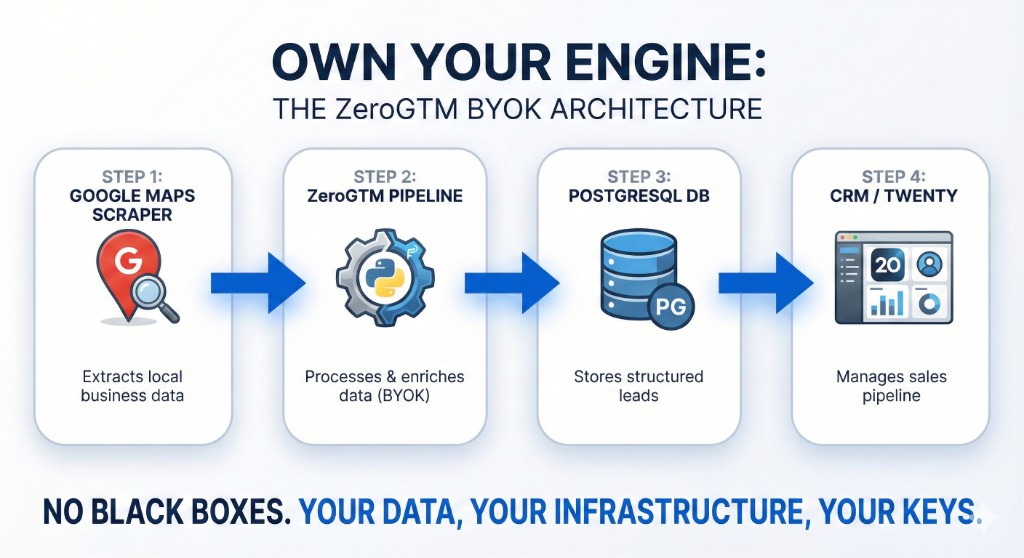
3. The Enrichment Engine: ZeroGTM
- Best for: GTM engineers who need a high-volume, self-hosted pipeline to generate leads from scratch.
- The tech: A Python-based worker architecture with a Supabase (PostgreSQL) backend and mobile-first control.
- The pros: Unlike a CRM, ZeroGTM is purpose-built for discovery. It automates a specific waterfall pipeline:
- Google Maps Scraper — Extracts local businesses via RapidAPI without manual copying.
- Contact Mining — Crawls websites to find social handles and generic emails via OpenWeb Ninja.
- Decision Maker ID — Identifies specific roles (CEOs, Founders) via “About Us” and LinkedIn cross-referencing.
- Verification — Validates emails via Anymail Finder to ensure deliverability.
- The advantage: It bridges the gap between raw data (Maps) and actionable contacts, running entirely on your infrastructure.
Why Open Source Matters for Enrichment
Why go through the trouble of self-hosting your enrichment layer instead of paying a SaaS vendor?
1. The “BYOK” (Bring Your Own Key) Economy
Closed platforms charge a markup on data. If they use OpenAI to summarize a lead, they charge you 5x the token cost.
- The ZeroGTM approach: With a BYOK architecture, you plug in your own API keys (RapidAPI, OpenAI, Anymail Finder). You pay the provider directly at raw cost. If a step uses your key, ZeroGTM does not deduct platform credits. This shifts your costs from variable SaaS subscriptions to controlled infrastructure spend.

2. Data Hygiene as Code
Bad data weaponizes AI against you. If you feed a sales agent dirty data, it generates hallucinations. Open-source tools allow you to implement automated hygiene tests. Tools like DataOps TestGen (another open-source player) can profile data and automatically generate hygiene checks for null anomalies and pattern violations before the data ever hits your CRM. ZeroGTM includes native “Clean Leads” and “Clean Spam” steps to filter off-target results before you pay for enrichment.
3. No Vendor Lock-In
The AI landscape moves fast. New models drop weekly.
- SaaS risk: If you use a closed AI SDR, you are stuck with their chosen LLM (often GPT-3.5 or 4o-mini to save them money).
- Open-source agility: With a self-hosted stack, you can swap the AI model used for casualizing names or generating icebreakers instantly. You can switch from OpenAI to Anthropic’s Claude 3.5 Sonnet to improve reasoning without waiting for a vendor update.
The Composable GTM Stack of 2026
The winner in 2026 isn’t the company with the biggest database; it’s the company with the best pipeline.
Don’t look for one tool to do it all. Build a stack:
- ZeroGTM — To scrape, identify, and verify high-intent local leads.
- n8n (open source) — To orchestrate the handoff logic.
- Twenty — To store the relationships and manage the deal flow.
By owning the engine, the fuel (data), and the keys, you build a lead generation asset that scales exponentially, not linearly.
Ready to deploy your own engine?
ZeroGTM self-hosted documentation →
Enrichment pipeline (step-by-step) →
Compare open-source vs Apollo & other tools →
Pricing & BYOK →
How to scrape Google Maps for B2B leads (2026) → · AI SDR vs Human SDR cost (2026) → · Cold email deliverability guide (2026) → · BYOK lead generation →