Target audience: Sales ops, GTM engineers, email marketers
Core theme: Deliverability as an engineering discipline
In 2026, email deliverability is no longer a “marketing art”—it is a strict engineering discipline. With Google and Yahoo enforcing rigorous bulk sender rules, and Microsoft joining them as of 2025, the era of “spray and pray” is mathematically impossible.
Inbox providers have shifted from simple content filtering to behavioral evaluation. They don’t just check if your email looks like spam; they check if you act like a spammer. For GTM engineers, this means your infrastructure, data hygiene, and sending velocity must be architected to mimic human behavior at scale.
Here is the technical blueprint for maintaining 90%+ inbox placement in 2026.
1. The Technical Baseline: Auth is Non-Negotiable
Before a single packet is sent, your authentication stack must be bulletproof. In 2026, missing these protocols guarantees rejection or the spam folder.
- SPF (Sender Policy Framework): The whitelist of IPs allowed to send mail for you. Crucial: ensure you don’t exceed the 10-lookup limit if you use multiple tools.
- DKIM (DomainKeys Identified Mail): The digital signature that proves the email wasn’t tampered with.
- DMARC (Domain-based Message Authentication, Reporting & Conformance): This is now mandatory. While a policy of
p=noneis a starting point, aim forp=quarantineorp=rejectto build maximum trust. - RFC 8058 (One-Click Unsubscribe): For marketing emails, you must include the List-Unsubscribe header. Google and Yahoo now require that unsubscribe requests be honored within two days.
The alignment rule: The domain in your “From” address must align with the domain in your DKIM signature or SPF record. Misalignment is a primary trigger for 2026 spam filters.
2. Infrastructure: The “Sharding” Strategy
Never send cold outreach from your primary corporate domain. If acme.com gets blacklisted, your CEO’s emails to investors will bounce.
The 2026 standard:
- Buy secondary domains: Use variations like tryacme.com or acme-partners.com. Treat the primary domain (e.g. acme.com) as protected—no cold outreach from it.
- Inbox volume caps: The “safe zone” for a warmed inbox is 30–50 emails per day. Pushing beyond 100/day per inbox is a statistical risk that triggers throttling algorithms. Cap each inbox at ~25–50/day and spread volume across 5–10 secondary domains with multiple inboxes each.
- Diversify providers: Don’t put all eggs in one basket. A robust stack often mixes Google Workspace inboxes with Microsoft 365 or specialized shared SMTP providers to hedge against provider-specific crackdowns.
Sharding isolates reputation risk and keeps your primary domain clean.
3. Engagement is the New Filter
Technical setup gets you to the door; engagement gets you inside. Spam filters in 2026 use AI to measure recipient intent.
- Positive signals: Replies, moving an email from Spam to Primary, marking as “Important.”
- Negative signals: Deleting without reading, reporting as spam.
- The 0.3% rule: If your spam complaint rate hits 0.3%, Google will block your domain. Ideally, stay below 0.1%.
This is why open rates are now a vanity metric (skewed by Apple’s Mail Privacy Protection). Focus on reply rate and inbox placement tests.
4. Warming: The Reputation Shield
You cannot spin up a domain and start selling on Day 1. You must “warm” the inbox to establish a history of legitimate behavior.
- Automated warming: Use tools that exchange emails with a network of real inboxes (not fake accounts). These tools automatically open your emails, mark them as important, and reply, generating positive engagement signals.
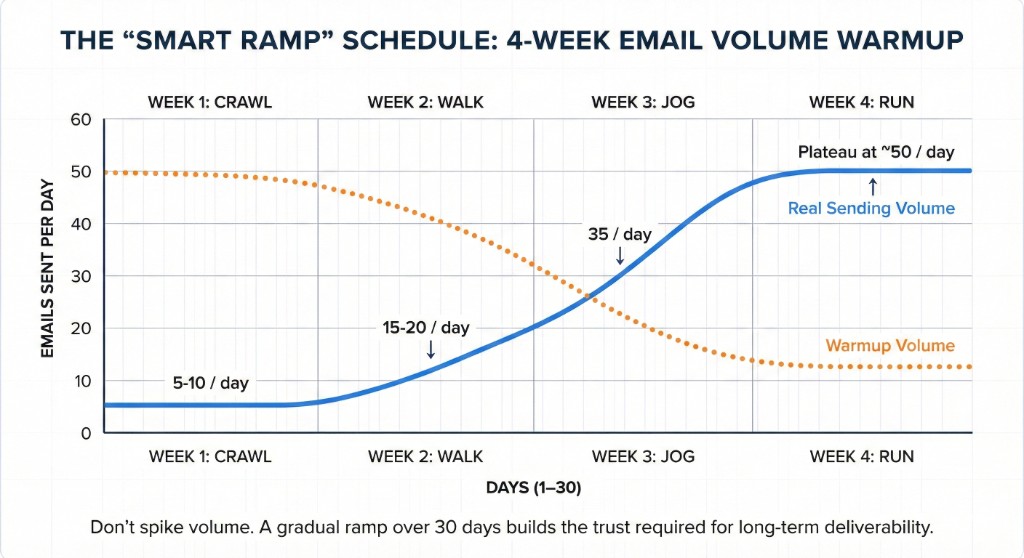
- The schedule:
- Days 1–14: Pure warming. Zero cold outreach.
- Days 15–30: Begin low-volume outreach (10–20/day) while keeping warming active.
- Ongoing: Keep warming active forever. It acts as a buffer, diluting the negative signals from non-responders in your cold list.
5. Data Hygiene: The ZeroGTM Advantage
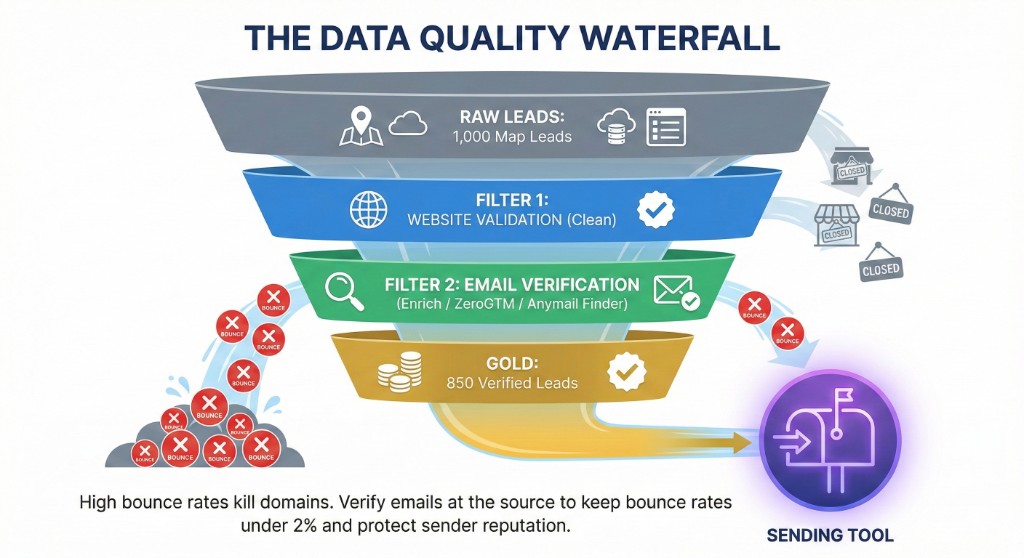
The fastest way to destroy a domain’s reputation is a high bounce rate. If your bounce rate exceeds 2–3%, you are flagged as a low-quality sender.
Deliverability doesn’t start with the email tool; it starts with the list.
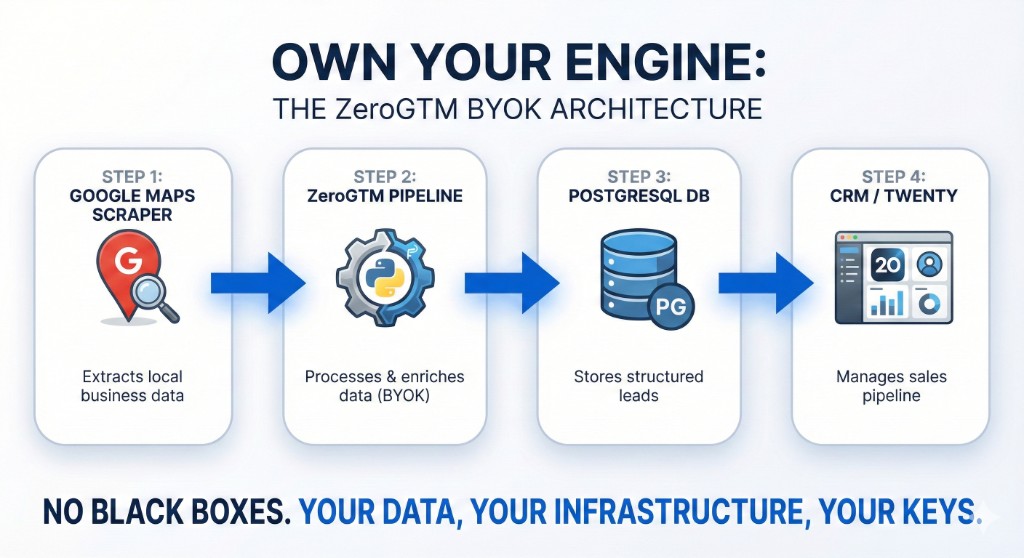
- Verification is mandatory: You must verify every email before sending. ZeroGTM’s pipeline (OpenWeb Ninja → Anymail Finder) ensures you aren’t guessing.
- Signal-based targeting: Sending to people who don’t care drives up spam complaints. By scraping Google Maps for businesses showing specific intent signals (e.g. highly rated but low review counts), you ensure relevance, which protects your 0.3% complaint threshold.
Conclusion: Deliverability is a System
You can have the perfect subject line, but if your infrastructure is weak or your data is dirty, you are shouting into the void.
Build a sharded infrastructure, automate your warming, and rigorously verify your leads with ZeroGTM to protect your reputation at the source.
ZeroGTM enrichment pipeline (verify before you send) →
Self-hosted setup →
Open source lead enrichment tools compared →
BYOK lead generation — why API key ownership matters →
Pricing & BYOK →