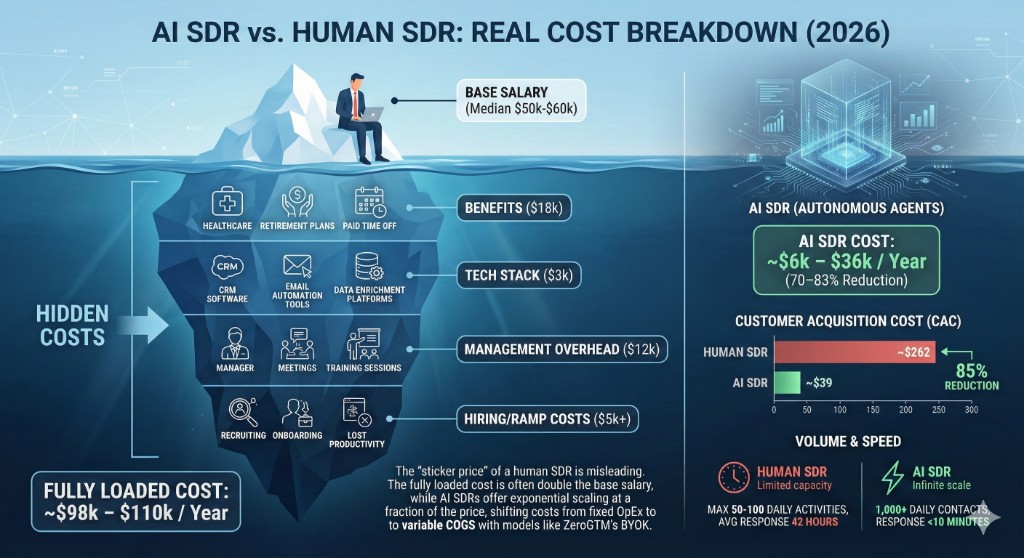
The “sticker price” of a Sales Development Representative (SDR) has always been misleading. In 2026, while the median base salary for a US-based SDR might sit around $50,000 to $60,000, the fully loaded cost—factoring in benefits, the modern tech stack, management overhead, and inevitable turnover—is realistically $98,000 to $110,000 annually.
For startups and growth-stage companies, this math is becoming harder to justify, especially when AI agents can now handle the top-of-funnel grunt work at a fraction of the price.
However, the decision isn’t just about cutting costs; it’s about unit economics, scalability, and conversion quality. Here is the real breakdown of AI vs. Human SDRs in 2026, and why a hybrid approach using Bring Your Own Key (BYOK) infrastructure is the new gold standard.
The True Cost of a Human SDR
When you hire a human SDR, you aren’t just paying a salary; you are paying for ramp time and inefficiency.
- Ramp Time: It takes an average of 3.1 to 3.2 months for a new SDR to reach full productivity. During this quarter, you are burning cash with minimal pipeline return.
- Turnover Tax: The average tenure of an SDR is only 14 to 16 months, with annual turnover rates hovering around 40%. Replacing a rep costs an estimated $115,000 when you combine hiring, training, and lost productivity.
- Actual Selling Time: Human reps spend only 18–28% of their day actually selling; the rest is consumed by manual research, CRM data entry, and internal meetings.
The Unit Economics of the AI SDR
In contrast, AI SDRs—autonomous agents that research, email, and qualify leads—scale exponentially rather than linearly.
- Cost Efficiency: Enterprise-grade AI SDR solutions typically range from $6,000 to $36,000 annually (or $500–$3,000/month), representing a 70–83% cost reduction compared to a human team.
- Customer Acquisition Cost (CAC): Data shows the cost to generate a single qualified lead drops from ~$262 (Human) to ~$39 (AI)—an 85% reduction.
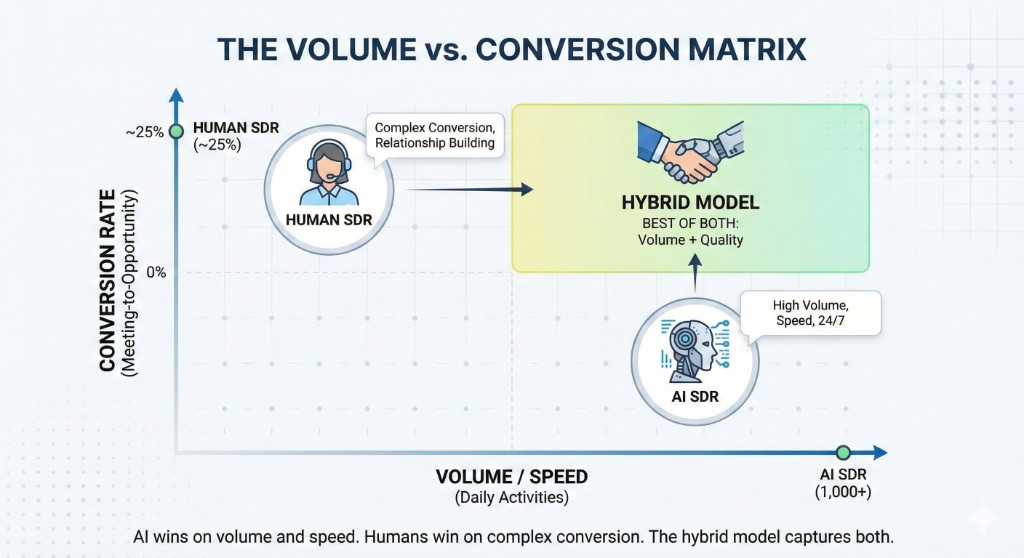
- Volume & Speed: A human SDR maxes out at ~50–100 activities per day. An AI agent can handle 1,000+ contacts daily without fatigue. Crucially, AI responds to inbound interest in under 10 minutes (often seconds), whereas humans average 42 hours. This speed alone can boost conversion probability by over 300%.
The ZeroGTM Difference: Escaping the SaaS Tax
While most AI SDR tools charge a monthly subscription (the “SaaS tax”), ZeroGTM leverages an open-source, Bring Your Own Key (BYOK) architecture.
- The Standard AI Model: You pay a vendor $2,000/month. They pay OpenAI $50 for your usage and keep the difference.
- The ZeroGTM Model: You pay $0 in per-seat fees. You plug in your own API keys (RapidAPI for Maps, Anymail Finder for emails, OpenAI for text). You pay only the raw cost of the data and compute you use. This shifts your cost structure from Fixed OpEx to Variable COGS—you only pay when you generate leads.
The Quality Gap (And Why Humans Still Matter)
Despite the cost advantages, AI is not a perfect replacement. There is a specific “Quality Gap” in 2026:
- Conversion Rates: Human SDRs typically achieve a ~25% meeting-to-opportunity rate, compared to ~15% for AI. Humans excel at navigating complex organizational politics, building emotional rapport, and handling nuanced objections that stump algorithms.
- Brand Risk: An unsupervised AI can “hallucinate” facts or send tone-deaf messages, potentially damaging your total addressable market (TAM).
The Winning Strategy: The Hybrid Model
The most successful GTM teams in 2026 don’t replace humans; they elevate them.
1. AI Handles the “Grunt Work” (Top of Funnel)
Use ZeroGTM to automate the labor-intensive steps:
- Google Maps Scraping — Extracting thousands of local businesses via API.
- Enrichment — Finding verified emails and phone numbers via OpenWeb Ninja and Anymail Finder.
- Decision Maker ID — Identifying the right contacts automatically.
2. Humans Handle the “Trust Work” (Bottom of Funnel)
Once a lead replies or shows high intent, the AI hands off the conversation. Human SDRs step in to conduct discovery, build relationships, and close the deal. This method has been shown to double active selling hours for human reps and reduce customer acquisition costs by ~25%.
Conclusion: Own Your Engine
Replacing a human SDR with AI isn’t just about saving money (though saving $70k per head is significant). It’s about building a scalable asset. With ZeroGTM, you aren’t renting a “black box” AI employee; you are building a lead generation engine where you own the data, the keys, and the process.
Ready to stop paying the markup?
Get started with the self-hosted ZeroGTM pipeline →
Compare ZeroGTM to human SDRs and other tools →
Pricing & plans →
How to scrape Google Maps for B2B leads (2026) →
Open source lead enrichment tools compared → · Cold email deliverability guide (2026) → · BYOK lead generation →